Larch is the conifer that behaves like a broadleaf. It carries needles and cones, yet every autumn those needles turn butter-yellow and drop, leaving a bare, twiggy skeleton through the winter. For anyone learning to identify trees in Britain, that single habit makes larch one of the easiest conifers to name.
It is also a tree with real character in a landscape: soft, hazy green in May, gold in October, and a knobbly, architectural outline in January. Here is what a beginner needs to know before planting one or trying to identify one.
The Odd One Out Among Conifers
Larches belong to the genus Larix, and they are deciduous. They are not the only deciduous conifers in the world — the swamp cypress and dawn redwood are two others — but in Britain the larch is by far the one you are most likely to meet in a field, a forest or a park.
European larch has been planted here for centuries, largely for timber, and Japanese larch arrived in the nineteenth century. Both became forestry staples because larch grows quickly, tolerates exposure, and produces hard, durable wood used for fence posts, cladding and boat planking. It was also once a common nurse tree, sheltering slower broadleaves such as oak until they could stand on their own.
Larch Through the Year
No other common British tree changes its appearance quite so dramatically. Keep an eye on a larch near you and the year reads like a story:
- Spring. Needles push out from knobbly spurs along the twigs, in a fresh, almost luminous green. Female cones appear as small pink-red tufts, like tiny raspberries, while male cones release clouds of yellow pollen.
- Summer. The crown fills out into a soft, feathery mass. The shade beneath a larch is light and dappled rather than gloomy, which is one reason ground plants cope under it better than under spruce or fir.
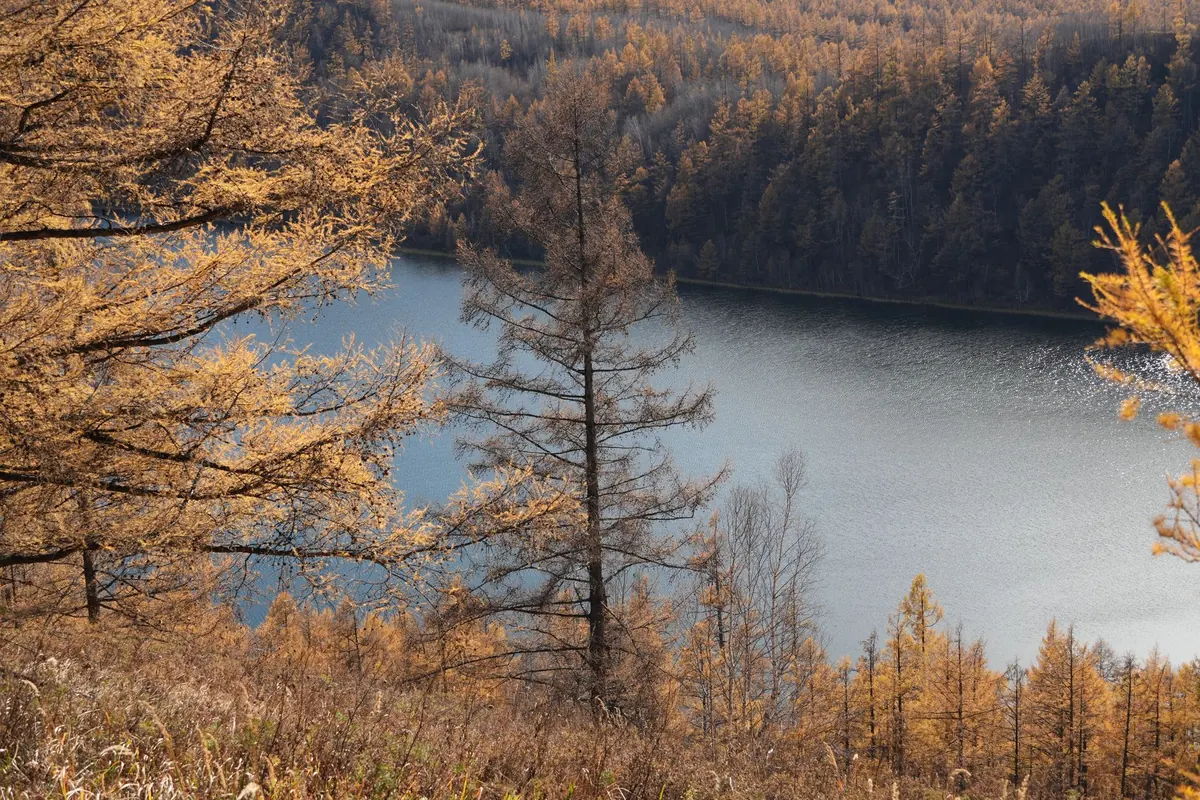
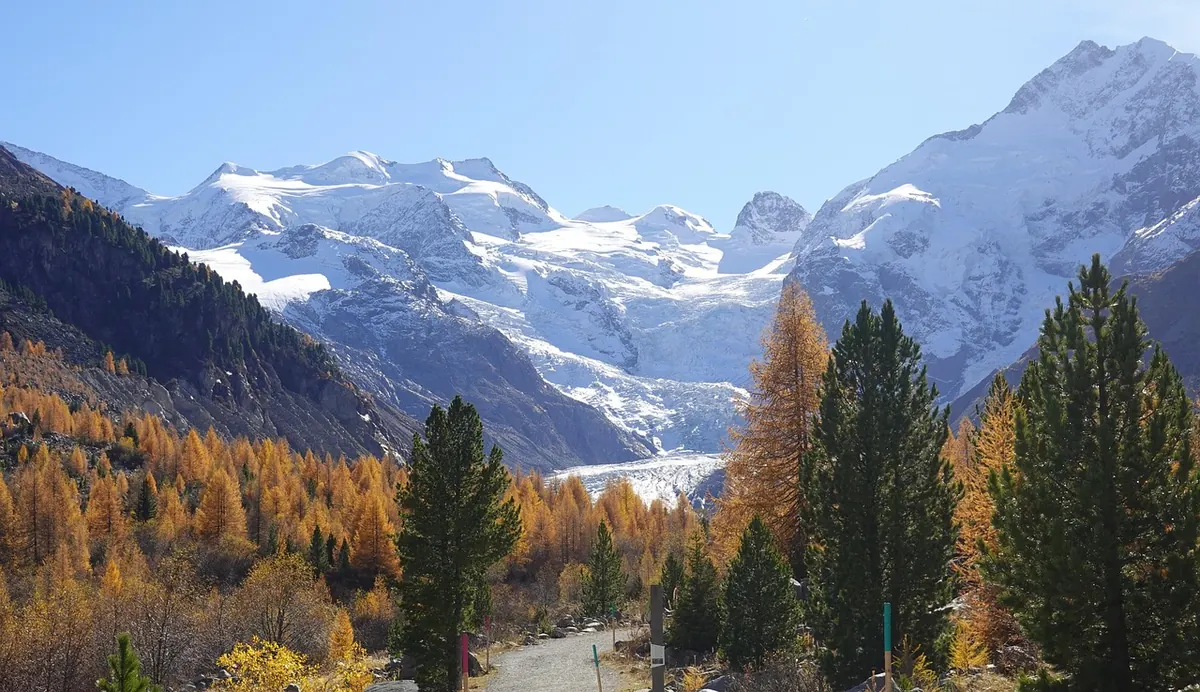
- Autumn. From late September the needles turn gold, then amber, before falling. A group of larches in a valley in October is hard to miss.
- Winter. The tree is bare, but the small, egg-shaped cones often stay on the twigs for a year or more, and the twigs themselves are studded with short woody pegs where the needles were attached.
How to Identify a Larch
Get close enough to touch a branch and the identification becomes straightforward. Larch needles are soft — you can run your hand along a twig without being jabbed, unlike spruce or holly. Beyond that, look for these features:
- Needles in tufts of roughly twenty to forty, growing from short woody spurs on older twigs. On fresh young shoots, the needles sit singly.
- Small cones, about 2–4cm long, egg-shaped and sitting upright along the top of the twig.
- Grey-brown bark that cracks into scaly plates with age.
- A narrow, conical crown with fine, slightly drooping twigs and a light, open texture.
- In winter, bare twigs covered in knobbly pegs — a reliable giveaway if you cannot remember which tree you are standing under.
If a tree is completely bare in January and still holding cones, you are almost certainly looking at a larch.
Which Larch Have You Found?
Three types account for nearly every larch in Britain, and they are usually told apart by needle colour and cone scales.
European larch (Larix decidua)
Needles are grey-green, around 2–3cm long, and the cone scales lie flat and neat, like roof tiles. It suits drier, inland sites and is the classic larch of estate plantings and upland shelterbelts.
Japanese larch (Larix kaempferi)
Needles are longer and noticeably bluer, and the cone scales curve outward at the edges — best seen by looking at a cone side-on. Young shoots often have an orange-pink glow in winter. It is the larch most planted in the wetter west of Britain, which is also where it has been hardest hit by disease.
Hybrid larch (Dunkeld larch)
A cross between the two, first raised at Dunkeld in Perthshire in the early twentieth century. It is vigorous and sits between its parents in appearance, which is exactly why it can be a frustrating tree to pin down. If precise identification matters — for a survey or a record, say — use a field guide alongside a fresh cone.
Does a Larch Suit Your Plot?
Be honest about space. A full-size larch will reach 20–30 metres on decent soil, with a crown to match, so it belongs in a large garden, a smallholding, a field corner or a woodland edge — not in a suburban back garden.
Given room, it is not fussy. Larch is a pioneer species: it wants open ground and plenty of light, and it will sulk in deep shade. It likes moist but free-draining soil, acid to neutral, and copes poorly with shallow chalk and with ground that sits wet all winter. It is hardy, wind-firm and well suited to exposed inland sites.
Two practical points worth knowing. First, a larch is not a hedge plant; it will not take repeated hard clipping into a tight formal line, so use it as loose shelterbelt planting with space to grow. Second, larch in Britain has been affected by Phytophthora ramorum, a fungus-like pathogen that has led to large-scale felling, particularly of Japanese larch in western areas. If you plan to plant more than a few trees, check current plant health guidance for your part of the UK before ordering.
For small gardens, look instead at weeping or dwarf larch cultivars, and always read the eventual height on the label rather than trusting the pot size.
Planting and Early Care
- Choose the spot first: sun for most of the day, and at least eight to ten metres of clear space from buildings, boundaries and overhead cables.
- Plant bare-root stock between November and March while it is dormant. Potted trees can go in almost any time the ground is neither frozen nor bone dry.
- Dig a hole wider than the rootball, keep the root collar level with the surrounding soil, backfill, firm gently and water well.
- Stake on exposed sites for the first two or three years, and check the ties each year so they do not cut into the trunk.
- Keep a metre-wide ring clear of grass and weeds for the first few seasons, topped up with mulch.
- Water through dry spells for the first two summers. After that, a larch largely looks after itself.
- Prune only young trees, and only in late summer or winter. Larch does not regrow from old wood, so remove dead or crossing branches rather than sawing into thick limbs.
A Sensible Starting Point
Ask yourself three questions. Do I have the room for a tree that may top twenty metres? Is my soil reasonably drained and not solid chalk? Do I actually want a conifer that goes bare each winter, rather than one that stays green?
Yes, yes and yes — and you have a tree that will earn its place: quick to establish, good for shelter, gorgeous in October, and interesting in every other month too. If any answer is no, a larch is not the wrong tree, just the wrong tree for that spot.
Photo: Tuor / Pixabay